
 суббота, сентября 14, 2013
 Unknown

| A+ A- |
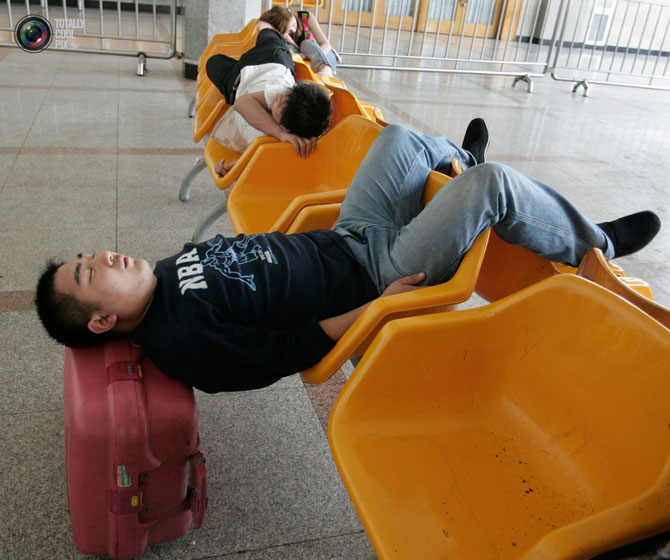
Где спят китайцы?


In
China, shopkeepers, factory workers, executives or waitresses take
several minutes out of their day for a sleep in their workplace, in
broad daylight, or in the street. People can be found snoozing balancing
on bicycles, at a workbench, or restaurant table, at the base of an
historical monument, or on an improvised seat, in plain view of passers
by.
Over the span of several years, Eric Leleu photographed these sleepers across the country. He regards the practice of napping as a sociological phenomenon that reveals a little known face of contemporary China. The sleepers are a testimony to a China where workers wake up early, go to bed late and recuperate with short naps during the day, showing a respect for biological rhythms, and an awareness of the body and its needs.
Workers escape from the present, taking a momentary time out, without fear of being seen. These candid siestas reveal the complex link in China between private and public spheres: private life overflowing onto the sidewalk; privacy integrating with the wider community.
---
Elsa Fayner, July 2008, Shanghai
Writer & journalist
Over the span of several years, Eric Leleu photographed these sleepers across the country. He regards the practice of napping as a sociological phenomenon that reveals a little known face of contemporary China. The sleepers are a testimony to a China where workers wake up early, go to bed late and recuperate with short naps during the day, showing a respect for biological rhythms, and an awareness of the body and its needs.
Workers escape from the present, taking a momentary time out, without fear of being seen. These candid siestas reveal the complex link in China between private and public spheres: private life overflowing onto the sidewalk; privacy integrating with the wider community.
---
Elsa Fayner, July 2008, Shanghai
Writer & journalist
En
Chine, commerçants, ouvriers, employeurs, ou serveurs s’endorment
souvent quelques minutes sur le lieu même de leur travail, en pleine
journée, en pleine rue. Ils se retrouvent en équilibre sur un vélo, sur
un établi, une table de restaurant, au pied d’un monument historique,
sur une chaise de fortune, au vu et au su de tous les passants.
Pendant
plusieurs années, Eric Leleu les photographie, partout dans le pays.
Pour lui, c’est un phénomène de société, qui révèle une face méconnue de
la Chine contemporaine. Les dormeurs témoignent d’une Chine dans
laquelle les travailleurs se lèvent tôt, se couchent tard, mais
récupèrent par ces courtes siestes, symboles d’un certain respect du
rythme biologique, d’une connaissance du corps et de ses équilibres.
Le
travailleur s’évade, se recueille quelques instants dans son
intériorité, sans crainte de laisser son corps exposé. Au-delà, ces
siestes en pleine rue illustrent le rapport complexe entre sphères
privée et publique qui s’est établi en Chine : la vie privée déborde sur
le trottoir, l’intimité s’expose à la collectivité.
---
---
Elsa Fayner, juillet 2008, Shanghai
Écrivaine & journaliste
Écrivaine & journaliste
 Posted in:


0 коммент.:
Отправить комментарий